BARNALA,PUNJAB,INDIA
Social Skills Training
In Barnala
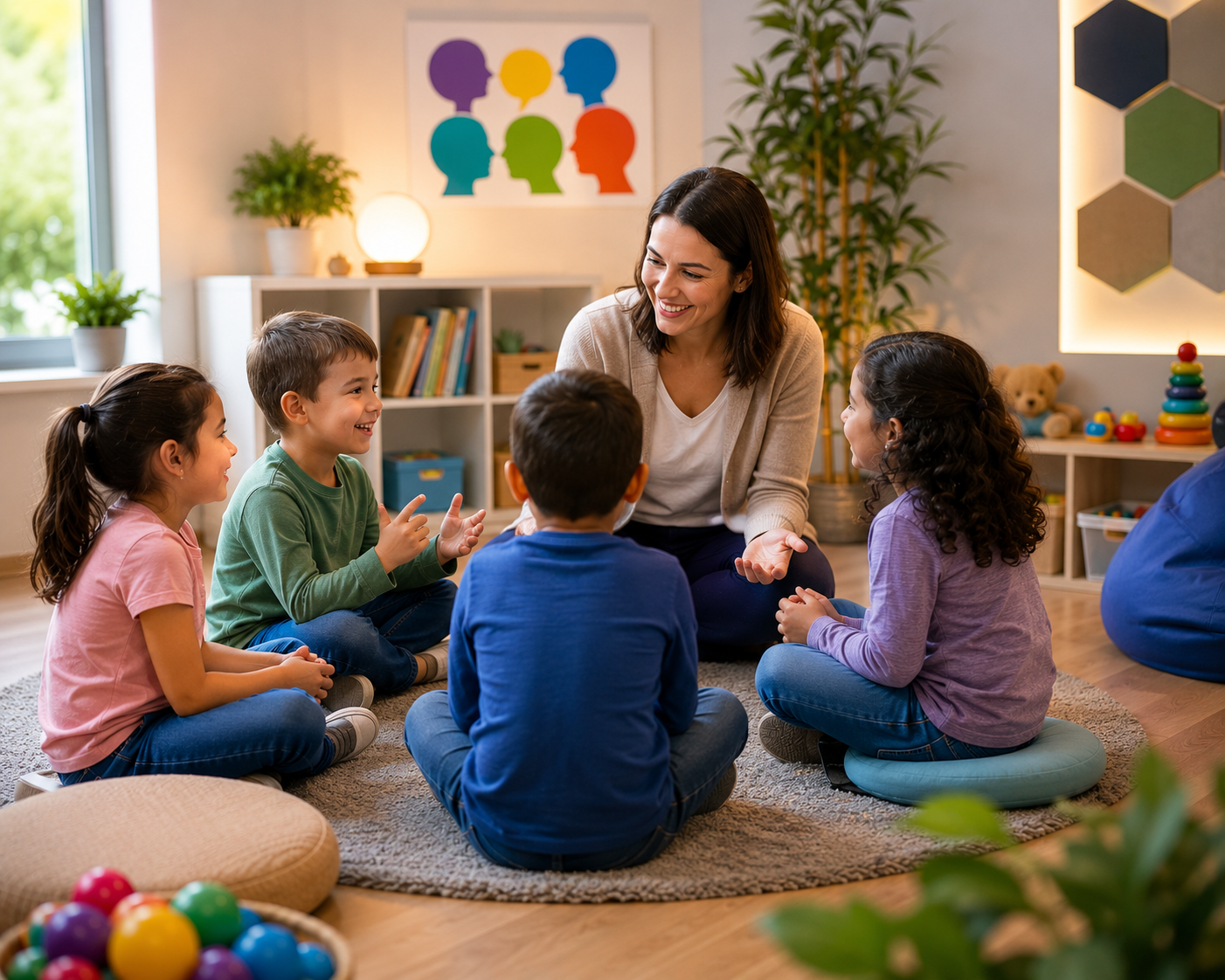
Building friendships, confidence, and communication — one connection at a time. Our expert social skills trainers in Barnala help children and adults with autism, ADHD, social anxiety, and communication difficulties learn the real-world social tools they need to thrive at home, at school, and in the community.
Understanding Social Skills Training
What Is Social Skills Training and Why Does It Matter in Barnala?
Social skills training (SST) is a structured, evidence-based intervention designed to teach individuals the specific verbal and non-verbal behaviours, communication strategies, and social understanding needed to interact successfully with others. Social skills are not a single ability — they are a rich and complex set of competencies that include making and maintaining eye contact, initiating and sustaining conversations, reading facial expressions and body language, understanding the unspoken rules of social interaction, managing disagreements, sharing, taking turns, and knowing how to behave appropriately in different social contexts such as the classroom, the family gathering, the sports ground, or the workplace.
Most children absorb social skills naturally — through play, observation, conversation, and social immersion in family, school, and community life. But for many children and adults in Barnala, this natural social learning process does not happen automatically. Children with autism spectrum disorder, ADHD, anxiety disorders, learning disabilities, or social communication difficulties may miss critical social cues, misread social situations, struggle to initiate friendships, or find the unpredictable nature of social interaction overwhelming. Without targeted intervention, these social difficulties can compound over time — leading to loneliness, school refusal, bullying, academic underachievement, and in adulthood, difficulty maintaining employment and relationships.
In Barnala — a vibrant, community-oriented city where social connections, family gatherings, neighbourhood relationships, and school participation are central to daily life — the ability to navigate social situations confidently is particularly important. Social isolation in Barnala's tight-knit communities can be especially painful, and the stigma experienced by children who seem "different" in social situations can profoundly damage their self-concept and mental health. Social skills training at our ConnectWell centre in Barnala directly addresses this — giving children and adults the specific tools they need to participate fully in Barnala's rich social and community life.
Social skills are not about making someone into a different person. They are about giving every person the tools to express who they already are — and to be truly seen and heard by others.
Did you know? Research consistently shows that children with strong social skills are not only happier — they perform better academically, have higher self-esteem, are more resilient in the face of challenges, and have better mental health outcomes in adulthood. Investing in social skills training in Barnala is investing in a child's lifelong wellbeing, not just their ability to make friends today.
Who We Help
Who Benefits from Social Skills Training in Barnala?
Social skills training at our Barnala centre serves a wide and diverse population. While children with autism are the most commonly referred group, social skills training is relevant and highly effective for many other individuals across childhood and adulthood.
Children with Autism Spectrum Disorder (ASD)
Social communication is a core area of challenge in autism, making social skills training one of the most important interventions for children with ASD in Barnala. Children with autism may struggle with reading social cues, understanding unwritten social rules, maintaining conversations, managing the unpredictability of group interactions, and developing reciprocal friendships. Our autism-specific social skills programs in Barnala use structured, visual, and highly explicit teaching of social concepts — taking nothing for granted and explicitly teaching what neurotypical children absorb intuitively. We use social stories, video modelling, role play, and structured peer interaction to build real-world social competencies that generalise to home, school, and community settings in Barnala.
Children and Adults with ADHD
Attention Deficit Hyperactivity Disorder significantly affects social functioning — not because children with ADHD do not understand social rules, but because impulsivity, inattention, and hyperactivity repeatedly interfere with their ability to apply those rules consistently. A child with ADHD in Barnala may interrupt frequently, dominate conversations, miss what a friend is saying because their attention has drifted, react disproportionately to minor social frustrations, or struggle to wait their turn in group activities. Our social skills training for ADHD in Barnala focuses on building self-monitoring, impulse regulation, active listening, and frustration management alongside explicit social skill instruction — addressing both the social knowledge and the executive function needed to use it.
Children with Social Anxiety and Shyness
Social anxiety is one of the most common mental health conditions affecting children and adolescents, and it is frequently underidentified in Barnala — where shy or withdrawn behaviour is sometimes accepted as a personality trait rather than recognised as a treatable condition causing real distress. Children with social anxiety in Barnala may avoid school, refuse to participate in class, struggle to make friends, feel physically ill before social events, and experience intense fear of negative evaluation by others. Social skills training combined with cognitive-behavioural techniques builds both the skills and the confidence for children with social anxiety to engage in social situations — gradually and with support until they can manage independently.
Children with Language and Communication Disorders
Children in Barnala with receptive or expressive language disorders, pragmatic language difficulties, or developmental language disorder (DLD) often struggle with the social use of language — the rules governing conversation such as how to take turns, how to stay on topic, how to introduce new information, how to respond to indirect requests, and how to use language appropriately in different social contexts. Social skills training that explicitly targets pragmatic language use is a core component of our work with these children in Barnala, and is delivered in close collaboration with our speech-language pathology team.
Children with Learning Disabilities
Children with dyslexia, dyscalculia, or other learning disabilities in Barnala often experience social difficulties secondary to their academic struggles — reduced self-confidence, avoidance of school activities, social withdrawal, or difficulty in group learning situations. Social skills training helps these children develop the confidence and communication tools to participate more fully in classroom and peer social life, advocate for themselves with teachers, and build positive peer relationships that support their overall academic and emotional wellbeing.
Adults with Social Communication Difficulties
Social skills training is not exclusively for children. Adults in Barnala with autism, social anxiety, acquired communication difficulties following stroke or brain injury, or lifelong social communication challenges benefit significantly from structured adult social skills programs. Our adult program focuses on professional communication, workplace social skills, building and maintaining adult friendships, navigating family social situations, and developing the social confidence needed to participate fully in community life in Barnala.
Autism (ASD)
ADHD
Social Anxiety
Language Disorders
Learning Disabilities
Down Syndrome
Intellectual Disability
Selective Mutism
Post-Stroke Adults
General Shyness
Core Social Skills
The Social Skills We Build in Barnala
Effective social skills training is not a single program or a set of rules to memorise. It is a comprehensive developmental process that builds a wide range of interconnected social competencies. Here are the core skill domains we address at our Barnala social skills training centre.

Eye Contact
Natural, comfortable gaze during conversation

Conversation
Starting, sustaining, and ending conversations

Turn Taking
Waiting, listening, and sharing in interaction

Emotion Reading
Identifying feelings in self and others

Empathy
Understanding and responding to others' feelings

Play Skills
Joining games, sharing, cooperative play

Personal Space
Physical boundaries and body language awareness

Problem Solving
Navigating social conflicts and disagreements

Perspective Taking
Understanding others' points of view

Assertiveness
Expressing needs and opinions confidently

Self-Regulation
Managing emotions in social situations

School Social Skills
Classroom participation, peer interaction
Our Programs
Social Skills Training Programs Offered in Barnala
Our ConnectWell centre in Barnala offers a variety of social skills training formats tailored to different ages, ability levels, and social learning needs. Every program is grounded in evidence and personalised to the individual.

Early Social Play Program
Play-based social skills development for toddlers and preschoolers — building parallel play, joint attention, turn-taking, sharing, and early friendship foundations in Barnala.

Junior Social Builders
Structured group program for primary-age children — developing conversation skills, emotion understanding, classroom social skills, and peer friendship in a fun group setting.

Tween Connection Club
Social skills group for pre-adolescents navigating the complex social world of middle school — covering peer pressure, inclusion, online communication, and self-advocacy.

Teen Social Skills Program
Advanced program for teenagers — dating etiquette, school social dynamics, handling conflict, interview skills, and preparing for adult social and professional life in Barnala.

Adult Social Confidence Program
Workplace communication, professional networking, adult friendship skills, and community participation for adults in Barnala with social communication difficulties.

PEERS® Social Skills Program
The internationally validated PEERS® program — evidence-based social skills training for adolescents with autism, ADHD, and social difficulties, adapted for Barnala's cultural context.

1-to-1 Social Skills Coaching
Individualised social skills coaching for children or adults who need personalised attention before or alongside group programs — targeting the most impactful goals first.

Parent & Family Coaching
Training parents, siblings, and grandparents in Barnala to be effective social skills coaches — creating daily social practice opportunities in natural home environments.
Individual vs Group Training
Individual vs Group Social Skills Training in Barnala
Both individual and group formats of social skills training have distinct advantages. Our Barnala centre offers both, and many children benefit from a combination of the two at different stages of their program.
Feature
Individual Training
Group Training
Learning Format
One-to-one with therapist — safe, controlled practice
Small group of 4–6 peers — real social dynamics
Best For
Building foundational skills, severe anxiety, or significant disability
Practising skills with real peers, building friendships
Generalisation
Skills require deliberate transfer to peer settings
Skills practised directly in social environment
Peer Relationships
Not directly developed in sessions
Genuine peer connections often form in group
Progress Rate
Faster skill acquisition — all focus on one child
Slower skill acquisition, richer real-world practice
Cost
Higher per session
More cost-effective — shared across group
Our Recommendation
Start here if very anxious, non-verbal, or severe ASD
Progress to group when foundation skills are in place
Our Process
How Our Social Skills Training Works in Barnala
From first contact to program completion, our Barnala social skills training journey is structured, transparent, and filled with meaningful milestones for children and families.
Initial Consultation and Social Profile
We begin with a detailed consultation in Punjabi, Hindi, or English — whichever is most comfortable for your family. Our trainer gathers a comprehensive social history: the child's current social circle, how they interact at home versus school, specific social situations they find challenging in Barnala, previous social experiences (positive and negative), family and cultural context, and the goals that matter most to the family. This conversation shapes the entire program that follows.
Comprehensive Voice Assessment
We assess the child's social skills profile using a combination of standardised social communication assessments, structured observation during play and interaction tasks, parent and teacher questionnaires, and where appropriate, direct observation of the child in their school setting in Barnala. This assessment identifies specific social strengths — which are always present and are actively built upon — as well as the social skill areas that are limiting the child's participation and wellbeing. The result is a clear, honest, and strengths-forward social profile that drives all program planning.
Personalised Social Skills Plan
Based on the assessment, our trainer develops a personalised social skills plan with specific, measurable goals for the child or adult. Goals are always functional and meaningful — tied to real social situations in Barnala such as joining a game at school recess, greeting a neighbour appropriately, contributing to a classroom discussion, or making a new friend at a community event. The plan specifies which program format (individual or group), which specific skills to target first, and how progress will be measured and reported to the family.
Structured Training Sessions
Social skills training sessions at our Barnala centre are structured, engaging, and activity-rich. Each session follows a consistent format — review of last session's home practice, introduction of a new skill concept, structured practice through role play and activities, and planning for home practice. For group sessions, carefully designed peer interaction activities provide authentic social practice opportunities within a safe, supported environment. Sessions are conducted in Punjabi and Hindi as well as English, and all activities use culturally relevant scenarios from everyday life in Barnala — familiar settings like the school, the gurdwara, the market, and the family gathering.
Home Practice and Generalisation
Social skills learned in the training room must generalise to real life in Barnala — the school playground, the family gathering, the neighbourhood, and the classroom. Every session provides families with specific, practical home practice activities designed to create social skill practice opportunities in the child's natural daily environment. Parents in Barnala are coached in how to set up social play dates, facilitate inclusive group activities, and provide natural, encouraging feedback during everyday social interactions. We believe the family is the most powerful social skills coach of all.
School Collaboration and Community Participation
Social skills training achieves its full potential when school environments in Barnala actively support and reinforce the skills being learned. Our trainers provide written reports and teacher consultation sessions for children's schools — giving teachers practical, workable strategies for supporting social inclusion in the classroom and on the playground. For older children and teenagers, we also work with community groups, sports clubs, and youth organisations in Barnala to create supported social participation opportunities that bridge the gap between the training room and the real social world.
Local Context
Social Skills Training in the Barnala and Punjab Context
Effective social skills training in Barnala must be deeply rooted in the specific cultural, linguistic, and community context in which the children and adults we serve actually live their social lives. Our ConnectWell team is not merely applying Western social skills curricula to a Punjabi context — we have thoughtfully adapted every aspect of our programs to be culturally meaningful and practically relevant for families in Barnala.
Social Skills in the Punjabi Family and Community Context
Punjabi families in Barnala typically have rich, complex, and highly interactive social lives — extended family gatherings, community celebrations, religious observances, neighbourhood relationships, and the social demands of joint family living. For a child with autism or ADHD in Barnala, these family and community contexts can be both a wonderful opportunity for social practice and a source of significant anxiety and overwhelm. Our social skills programs explicitly address the social demands of these culturally specific situations — including how to greet elders respectfully, how to navigate large family gatherings, how to participate in gurdwara social activities, and how to manage the intense sensory and social stimulation of a Punjabi wedding or festival.
Multilingual Social Skills Training in Barnala
Children in Barnala navigate social life across multiple languages — Punjabi at home, Hindi with friends and in the community, and English at school. Our social skills training explicitly addresses this multilingual social reality — teaching children how to initiate and maintain conversations, read social cues, and manage social situations in all three languages as appropriate. We also address the specific social codes and politeness conventions of Punjabi culture — the use of respectful address terms, the social rules around age and gender, and the community norms around turn-taking and listening in Punjabi social interaction.
Addressing Social Stigma Around Disability in Barnala
Social stigma around disability — including autism, ADHD, and intellectual disability — remains a real challenge for families in Barnala. Children with social difficulties may be labelled as "rude," "strange," or "badly brought up" rather than recognised as having a genuine neurological or developmental difference that responds to appropriate support. Our ConnectWell centre actively works to educate Barnala's families, schools, and community organisations about the nature of social communication differences — creating a more informed, compassionate, and inclusive community environment that supports the success of every child in our programs.
School outreach in Barnala: Our team conducts regular workshops for teachers and school counsellors across Barnala's primary and secondary schools — building awareness of social communication differences and equipping classroom teachers with practical peer inclusion strategies. If your school in Barnala is interested in our teacher training programs, please contact us to discuss a bespoke workshop for your staff.
FAQ
FAQs About Social Skills Training in Barnala
Here are answers to the questions we hear most from families in Barnala considering social skills training.
Is social skiil training effective for children with autism in Barnala?
Yes — social skills training is one of the most strongly evidence-based interventions for children with autism. Research consistently shows that structured, explicit social skills training programs lead to meaningful improvements in social communication, friendship quality, social motivation, and quality of life for children and adolescents with autism. At our Barnala centre, we use evidence-based approaches including the PEERS® program, social stories, video modelling, and cognitive-behavioural strategies adapted to the needs of each individual child. Outcomes are best when training begins early, is delivered consistently, and is reinforced by families and schools in Barnala in everyday social contexts.
How is social skill different from speech therapy?
Speech therapy primarily addresses how language is produced and understood — the sounds, words, grammar, and literal meaning of language. Social skills training addresses the pragmatic use of language in social contexts — how to use language appropriately with different people, in different situations, for different purposes. While there is significant overlap for children with autism or language disorders, social skills training goes beyond language to address all aspects of social interaction — body language, eye contact, reading social cues, managing emotions in social situations, and understanding the unwritten rules of social behaviour. Our Barnala centre integrates both where needed through our multidisciplinary team.
What age is best to start social skills training in Barnala?
The earlier the better — social skills development begins in infancy and the foundations for friendship, sharing, and communication are laid in the preschool years. We work with children as young as 2–3 years old through our early social play program. However, social skills training is beneficial at any age — adolescents and adults also make significant progress with appropriate programs. There is no age at which social skills training becomes ineffective. Our Barnala programs span from toddler play groups through to adult social confidence programs.
How many sessions of social skills will my child need in Barnala?
Most of our structured social skills programs in Barnala run for 12–20 weeks, with sessions once or twice weekly. The PEERS® program, for example, is a 16-week structured curriculum. Children with mild social difficulties may complete a program and maintain progress independently. Children with autism, significant social anxiety, or more complex social profiles may benefit from ongoing social skills support across multiple years, with program intensity adjusted as skills develop. We reassess regularly and are always honest with families about what their child needs.
Is social skill training is done in Punjabi in your Barnala centre?
Yes. All our social skills training programs in Barnala are available in Punjabi and Hindi as well as English. We believe deeply that social skills must be taught in the language and cultural context the child actually uses for social interaction — for most children in Barnala, that means Punjabi. All social stories, role-play scenarios, group activities, and home practice materials are culturally adapted and available in Punjabi and Hindi. Parent coaching sessions are also conducted in the family's preferred language.
Do you offer online social skills training from Barnala?
Yes. Individual social skills coaching and parent training sessions are available online for families across Punjab who cannot attend our Barnala centre in person. Online individual sessions are highly effective — video platforms actually offer a useful controlled social environment for practising conversation skills and interaction. Group social skills programs, however, are best delivered in person for maximum social learning impact. Our Barnala team works with families to create the best possible combination of in-person and online support for their specific circumstances.
How do you involve parents in social skills training in Barnala?
Parent involvement is absolutely central to our social skills programs. Parents in Barnala are not just observers — they are trained as social skills coaches for their child's daily life. Every session includes parent briefing and home practice guidance. We offer dedicated parent training workshops covering how to set up social play dates, facilitate peer interaction during outings and family gatherings, respond positively to social successes and setbacks, and advocate effectively for their child's social inclusion at school. Research consistently shows that children make far faster and more durable progress when parents are active participants in the social skills training process.
Help Your Child Connect, Belong, and Thrive in Barnala
Every child deserves to have friends, feel included, and participate fully in
their community. Our Barnala social skills team is ready to help. First
consultation is completely free — no referral needed.