Pediatric Audiology & Speech Therapy
Auditory Training
for Hearing-Impaired Children
A complete, evidence-based guide for parents, educators, and therapists on how structured listening training transforms outcomes for children with hearing loss — from early identification through advanced communication development.
3,000
Words
11
Sections
1 in 500
Newborns Affected
Early
Intervention Key
Table of Contents
- 1.Introduction
- 2.Early Identification & Newborn Screening
- 3.What Is Auditory Training?
- 4.Stages of Auditory Skill Development
- 5.School & Classroom Strategies
- 6.Conclusion
- 7.Understanding Hearing Loss in Children
- 8. Hearing Technology
- 9.Auditory-Verbal Therapy (AVT)
- 10. Core Techniques & Activities
- 11.Family's Role in Auditory Training
Introduction: The Power of Listening
Sound is the invisible architecture of language. Long before a child speaks their first word, they are immersed in a rich acoustic world — the voice of a parent, the rhythms of music, the ambient sounds of a busy household. This constant sensory bath of sound is not incidental to language development; it is its very foundation. The human brain, in the first years of life, is engaged in an extraordinary process of auditory learning: decoding the patterns of speech, mapping sounds to meanings, and building the neural infrastructure upon which all spoken communication will rest. This process depends, critically, on the ability to hear.
For the approximately 1 in 500 newborns born with a significant hearing loss — and for the many more who acquire hearing loss in childhood through illness, injury, or progressive conditions — this foundational auditory experience is absent or severely disrupted. Without intervention, the consequences extend far beyond the inability to hear: they cascade into delayed speech and language development, reduced academic achievement, social isolation, and diminished quality of life. Hearing loss, if unaddressed, is not simply a sensory impairment — it is a developmental challenge that touches every dimension of a child's growth.
The good news, supported by decades of scientific research and clinical evidence, is that auditory training — structured, systematic, technology-supported programmes designed to develop listening skills in children with hearing loss — can dramatically alter this trajectory. When combined with appropriate hearing technology (hearing aids or cochlear implants), delivered early, and supported by engaged families, auditory training enables many children with significant hearing loss to develop spoken language, communicate naturally, attend mainstream schools, and participate fully in hearing society. It is among the most consequential therapeutic interventions in pediatric healthcare.
This comprehensive guide covers everything parents, educators, and healthcare professionals need to understand about auditory training for hearing-impaired children: the nature of childhood hearing loss, the importance of early identification, the hearing technologies that make listening possible, the theoretical frameworks and practical techniques of auditory training, the developmental milestones practitioners work towards, strategies for home and school, and the profound difference that early, consistent, skilled intervention makes in a child's life.
1 in 500
Newborns with hearing loss
6 months
Ideal age for hearing aid fitting
2× faster
Language growth with early AVT
Understanding Hearing Loss in Children
Before exploring auditory training, it is essential to understand the landscape of childhood hearing loss: its types, degrees, causes, and the ways it affects a child's development. This foundation helps parents and professionals appreciate why specific interventions are recommended and what outcomes are realistic for a given child.
Types of Hearing Loss
Hearing loss in children is classified by the site of the auditory problem. Conductive hearing loss occurs when sound cannot be efficiently transmitted through the outer or middle ear — commonly due to ear infections (otitis media), fluid in the middle ear, or structural abnormalities. It is often temporary and may be medically or surgically treatable. Sensorineural hearing loss (SNHL) involves damage to the cochlea (the inner ear) or the auditory nerve, and is typically permanent. It is the most common type of significant hearing loss in children. Mixed hearing loss involves components of both conductive and sensorineural loss. Auditory neuropathy spectrum disorder (ANSD) is a condition in which sound enters the inner ear normally but the transmission of signals from the inner ear to the brain is disrupted, creating a particular pattern of inconsistent and distorted auditory processing.
Types of Hearing Loss

Mild
Difficulty with soft speech and distant voices. May miss word endings and consonants in noisy settings.

Moderate
Conversational speech is difficult without hearing aids. Significant impact on language development without intervention.

Profound
Minimal or no auditory perception. Cochlear implants considered. Exceptional outcomes possible with early intervention.

Severe
Cannot hear most speech sounds without powerful amplification. Language development heavily dependent on early intervention.
Causes of Hearing Loss in Children
Approximately 50% of childhood hearing loss has a genetic cause — with mutations in the connexin 26 gene (GJB2) being among the most common in cases of congenital sensorineural hearing loss. Non-genetic causes include: prenatal infections (cytomegalovirus, rubella, toxoplasmosis); prematurity and low birth weight; hypoxia at birth; neonatal jaundice requiring exchange transfusion; ototoxic medications; bacterial meningitis (a leading cause of acquired childhood hearing loss); and chronic ear infections. In approximately a third of cases, the cause remains unknown despite thorough investigation.
Understanding the cause of hearing loss is clinically important because it can influence the choice of hearing technology, predict whether hearing will remain stable or progress, identify associated conditions, and guide genetic counselling for the family.
Early Identification and Newborn Hearing Screening
The single most important predictor of outcomes for children with hearing loss is the age at which the hearing loss is identified and intervention begins. Research is unequivocal on this point: children whose hearing loss is identified in the first months of life and who receive hearing technology and auditory training before the age of six months consistently achieve significantly better spoken language outcomes than those whose diagnosis is delayed. The window of auditory brain development is time-sensitive, and every month without appropriate auditory input carries a cost that becomes progressively harder to recover.
This understanding is what drove the worldwide establishment of Universal Newborn Hearing Screening (UNHS) programmes. Prior to universal screening, the average age at which childhood hearing loss was diagnosed was two to three years — well past the most critical window for auditory brain development. Today, in countries with comprehensive screening programmes, hearing loss can be identified in the first days or weeks of life.
Screening Methods
Two primary techniques are used in newborn hearing screening. Otoacoustic Emissions (OAEs) test the function of the outer hair cells in the cochlea by placing a small probe in the ear canal, delivering brief sounds, and measuring the echo that a healthy cochlea produces in response. OAE testing is quick, non-invasive, and can be performed while the baby sleeps. Automated Auditory Brainstem Response (AABR) testing measures the auditory nerve and brainstem's electrical response to sound, using small electrodes placed on the baby's head. It detects a wider range of auditory conditions, including auditory neuropathy spectrum disorder, which OAEs alone may miss.
Most screening programmes use a two-stage approach: all newborns receive an OAE screen, and those who do not pass are referred for AABR before being referred for full diagnostic assessment. A failed newborn screen requires prompt follow-up; it does not confirm hearing loss, but it initiates the diagnostic process that will either rule out or confirm a hearing difficulty and set the course for early intervention.
🎯 The 1-3-6 Early Hearing Detection & Intervention (EHDI) Goa
- 1.Screen by 1 month — All newborns screened for hearing loss before leaving hospita
- 2.Diagnose by 3 months — Hearing loss confirmed through full audiological assessment by age 3 month
- 4.Intervention by 6 months — Hearing technology fitted and auditory training/family support begun by 6 months of age
Meeting this 1-3-6 benchmark consistently produces dramatically better language and literacy outcomes compared to later identification and intervention.
Hearing Technology: The Foundation of Auditory Access
Auditory training is only possible when a child has adequate access to sound. The fundamental prerequisite for any auditory training programme is therefore appropriate, optimally fitted hearing technology. Without it, the child's auditory system lacks the acoustic input needed to develop listening skills, and auditory training cannot proceed effectively. Two primary categories of hearing technology are relevant for children with hearing loss: hearing aids and cochlear implants.
Hearing Aids
Modern digital hearing aids are sophisticated signal processing devices that amplify and shape sound to match the specific contours of a child's hearing loss. They are typically the first technology fitted for children with mild to severe hearing loss. Behind-the-ear (BTE) hearing aids — with a custom-moulded earmould fitting snugly in the outer ear — are almost universally used for children because they accommodate growing ears (requiring only earmould replacement rather than new hearing aids as the child grows), are robust, and allow for the necessary range of amplification. Paediatric audiologists use a process called real ear measures (or probe microphone measures) to verify that the hearing aid is delivering the precise amplification targets needed for speech audibility.
For auditory training to succeed, hearing aids must be worn consistently — every waking hour — from the time of fitting. This requires dedicated family commitment, particularly in the early months when fitting is new and the child may resist wearing devices. Audiologists, auditory-verbal therapists, and specialist teachers of the deaf work intensively with families to support this consistent hearing aid use, which is non-negotiable for optimal outcomes.
Cochlear Implants
For children with severe to profound hearing loss who receive limited benefit from hearing aids, the cochlear implant represents a transformative technology. Unlike a hearing aid, which amplifies sound, a cochlear implant bypasses the damaged cochlea entirely and directly stimulates the auditory nerve with electrical signals. It consists of an external sound processor worn behind the ear (which captures and processes sound) and an internal device surgically placed under the skin with an electrode array threaded into the cochlea.
Cochlear implantation in young children — when performed early (ideally before 12–18 months in profoundly deaf children) and followed by intensive auditory training and rehabilitation — produces outcomes that were considered impossible a generation ago. Many children with profound hearing loss who receive early cochlear implants develop spoken language indistinguishable from their hearing peers, attend mainstream schools without specialist support, and go on to participate fully in hearing society. The cochlear implant is arguably the most successful neural prosthesis in the history of medicine.
Assistive Listening Technology
Beyond hearing aids and cochlear implants, remote microphone systems (formerly called FM systems) play a critical role in educational settings. A remote microphone worn by the speaker transmits the voice directly to the child's hearing aid or implant processor via a radio signal, bypassing the acoustic interference of distance, reverberation, and background noise. In a classroom environment — where background noise levels routinely exceed the comfortable listening threshold for children with hearing loss — remote microphone systems significantly improve speech intelligibility and reduce listening effort, supporting both learning and fatigue management.
"Consistent, optimal use of hearing technology is not optional — it is the non-negotiable foundation upon which all auditory learning is built."
— Principles of Auditory-Verbal Practice, AG Bell Academy
What Is Auditory Training?
Auditory training is a structured, goal-directed therapeutic approach designed to help hearing-impaired individuals — especially children — learn to use their residual hearing (whether unaided or amplified through hearing technology) to the maximum possible extent. It is grounded in the neuroscientific understanding that the auditory brain is not simply a passive receiver of sound but an active, experience-dependent system that develops and refines its processing capabilities in response to auditory input. The more rich, varied, and meaningful auditory experience a child receives, the more effectively the auditory pathways of the brain are organised and strengthened.
Auditory training is not a single technique but a family of related approaches sharing a common foundation. All are based on the principle that listening is a learnable skill — that through systematic practice, instruction, and experience, a child with hearing loss can develop increasingly sophisticated abilities to detect, discriminate, identify, and comprehend sounds and speech, even when listening conditions are challenging. This stands in stark contrast to older educational approaches that assumed children with hearing loss were primarily visual learners and should rely on lipreading and sign language rather than developing listening skills.
Contemporary auditory training for children is almost always embedded within a broader early intervention and communication development framework. It is delivered by a team that typically includes audiologists (responsible for hearing assessment and technology management), auditory-verbal therapists or speech-language pathologists with specialist hearing loss training, specialist teachers of the deaf, and — most importantly — the child's own family, who are coached to embed auditory learning opportunities throughout every aspect of daily life.
Detection
Learning to notice when a sound is present versus absent — the most basic auditory skill and the starting point for all listening development.

Discrimination
Recognising that two sounds are the same or different — a prerequisite for learning to identify specific sounds and words.

Identification
Labelling a sound or word correctly without visual cues — demonstrating true auditory recognition from memory.
Comprehension
Understanding spoken language in context — the highest level of auditory skill, enabling full participation in conversation and learning.
Auditory-Verbal Therapy (AVT): Principles and Practice
Among the various approaches to auditory training for children with hearing loss, Auditory-Verbal Therapy (AVT) has emerged as one of the most rigorously practised and extensively researched. Developed and refined over several decades by pioneers including Doreen Pollack, Helen Beebe, and Daniel Ling — and further formalised by the AG Bell Academy for Listening and Spoken Language — AVT is a family-centred approach dedicated to helping children with hearing loss develop listening and spoken language as their primary mode of communication.
AVT is grounded in ten guiding principles that distinguish it from other approaches. Among the most important are: the promotion of early diagnosis and optimal hearing technology fitting; the active teaching of listening as the primary sensory modality for communication development; the deliberate minimisation of visual cues (including lipreading) during therapy, to train the auditory system to work as independently as possible; the integration of listening and spoken language goals into all aspects of the child's natural daily experiences; and the central, coaching-oriented role of parents and caregivers, who are viewed not as observers of therapy but as the primary agents of the child's auditory and language learning.
The Role of the AVT Therapist
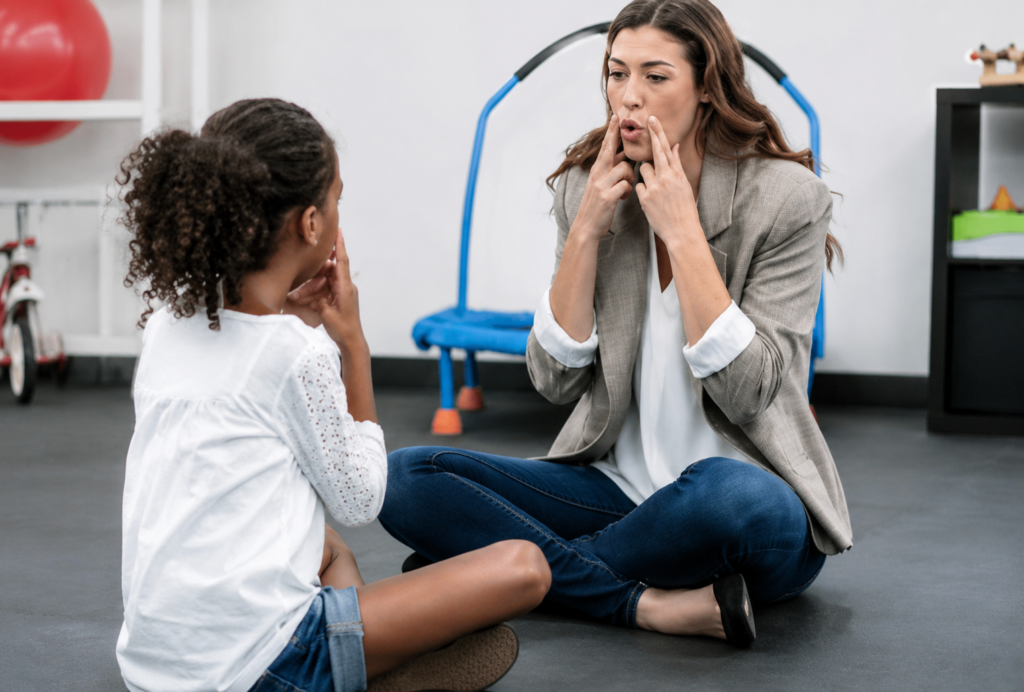
An AVT therapist — formally a Listening and Spoken Language Specialist (LSLS) certified by the AG Bell Academy — does not simply work with the child. They work with the family. A typical AVT session involves a period of direct interaction with the child alongside the parent, followed by explicit coaching of the parent in the strategies demonstrated — helping them understand not just what activities were done but why, and how to apply the same strategies independently throughout the week. This coaching model acknowledges a critical truth: a child spends perhaps one hour per week in therapy and every remaining waking hour in the family environment. The quality of auditory and language learning during that vast majority of time depends entirely on the family's understanding and implementation of therapeutic principles.
✦ Core Principles of Auditory-Verbal Therapy
- 1.Promote early identification and optimal hearing technology as the foundation for listening
- 2.Guide, coach, and support parents to be the primary facilitators of their child's listening and spoken language development
- 3.Teach the child to use hearing as the primary sensory modality for communicatio
- 4.Encourage the child to monitor their own voice using auditory feedback
- 5.Use natural play, daily routines, and meaningful activities as the primary vehicle for auditory and language learning
- 6.Administer ongoing, formal audiological monitoring throughout intervention
Stages of Auditory Skill Development
Auditory skill development in hearing-impaired children follows a broadly sequential pattern that mirrors, to a significant degree, the natural sequence of auditory development seen in typically hearing infants and children. Understanding this developmental progression is essential for setting appropriate therapy goals, measuring progress, and communicating expectations to families. The most widely used framework in clinical practice is Daniel Ling's Six Sound Test combined with the Erber Hierarchy of Auditory Skills — together providing both a monitoring tool and a developmental roadmap.
Age / Stage
Typical Auditory Milestones
Therapy Focus
0–3 months
Stills or startles to loud sounds; quiets to familiar voice; responds to parent's voice with increased alertness
Consistent hearing aid wear; parental voice emphasis; awareness training
3–6 months
Turns eyes or head toward sound source; vocalises in response to voice; recognises parent's voice
Localisation activities; vocal play; auditory conditioning with objects
6–12 months
Actively searches for sound sources; responds to name; understands "no"; imitates intonation patterns
Name recognition; sound-object association; suprasegmental awareness (rhythm, stress, intonation)
12–18 months
Follows simple verbal directions; identifies body parts when named; first words emerge
Vocabulary building; closed-set auditory discrimination; object identification without visual cues
18–36 months
Vocabulary expands rapidly; two-word phrases; understands simple questions; discriminates similar-sounding words
Minimal pair work; sentence-level listening; open-set word recognition; connected speech processing
3–5 years
Follows multi-step directions; understands stories; carries on conversations; processes speech in noise
Listening in degraded conditions; narrative comprehension; auditory memory; phonological awareness for literacy
The Ling Six Sound Test
The Ling Six Sound Test is an indispensable daily monitoring tool in any auditory training programme. The six sounds — /m/, /ah/, /oo/, /ee/, /sh/, /s/ — were selected by audiologist Daniel Ling because together they span the full frequency range of speech (from approximately 250 Hz for /m/ to 4000+ Hz for /s/) and can be produced by voice at conversational level. By presenting these sounds to the child (without lip cues) and asking them to detect or identify them, caregivers and therapists can quickly determine whether the child's hearing aids or cochlear implants are functioning properly and providing access to the speech spectrum — making it a powerful screening tool for both auditory skill monitoring and technology troubleshooting.
Core Techniques and Therapeutic Activities
Effective auditory training weaves together a rich variety of structured activities, play-based exercises, and everyday routines, all designed to challenge the auditory system at the appropriate developmental level and to make listening a natural, enjoyable, and rewarding experience. The following represent the most important and widely used therapeutic techniques in auditory training practice.
Acoustic Highlighting
The therapist and trained parent deliberately draw the child's attention to specific sounds and speech patterns by modifying how they speak: placing their mouth close to the child's microphone, exaggerating the stress on target words, pausing before key words to create anticipation, and repeating important sounds with clear, natural emphasis. Acoustic highlighting makes the auditory signal more salient without distorting it, helping the child "tune in" to the features of speech that are most important for discrimination and learning.
Auditory Sandwich Technique
A structured presentation sequence in which a word, phrase, or sound is: (1) presented auditorily only (no lip cues); (2) presented with full visual and auditory information if the child does not respond correctly; and then (3) presented auditorily only again for a second attempt. This technique ensures that the auditory system is always given the first opportunity to process information independently, while visual support is available when genuinely needed — and the final auditory-only presentation reinforces the auditory pathway as the primary channel.
Minimal Pair Auditory Discrimination Training
Minimal pairs are words that differ in a single phonemic feature (e.g., "bat" vs "pat," "cup" vs "pup," "shoe" vs "chew"). By practising discrimination between such pairs in structured games and activities, children develop fine-grained auditory processing of the phonemic contrasts that underlie spoken English, directly building the perceptual foundations for both speech production and literacy skills.
Listening and Language Games
Play-based activities — including barrier games (where child and therapist sit on opposite sides of a barrier and communicate only verbally to complete a task), auditory memory games (remembering and following multi-step spoken instructions), sound discrimination sorting tasks, and story sequencing through listening — make auditory training enjoyable while targeting specific listening skills at the appropriate developmental level.
Acoustic Environment Management
Therapists train families and educators to systematically optimise the listening environment. This includes: reducing background noise (turning off televisions and music during key learning times); improving room acoustics (using soft furnishings to reduce reverberation); maintaining an appropriate talking distance; ensuring the child's hearing aids or implant processors are always functioning; and using remote microphone systems in educational settings. Listening in a well-managed acoustic environment builds auditory skills more efficiently than struggling in a noisy one.
Phonological Awareness Training
As children approach school age, auditory training increasingly incorporates phonological awareness activities — rhyming, syllable segmentation, phoneme blending, and sound-letter correspondence games — that build the auditory-phonological foundations for reading and spelling. Research demonstrates that children with hearing loss are at elevated risk for literacy difficulties, and that early phonological awareness training significantly mitigates this risk when paired with appropriate acoustic access.
Auditory Training in Noise
The ultimate goal of auditory training is not merely to understand speech in quiet conditions but to function effectively in the noisy, reverberant environments of everyday life. Progressive training in degraded listening conditions — gradually introducing background noise, distance, or competing voices as the child's skills develop — builds the neural robustness needed for real-world auditory function. This stage of training is typically introduced once the child has established solid foundational auditory skills in quiet conditions.
School and Classroom Strategies for Hearing-Impaired Children
The educational environment presents some of the most significant auditory challenges in a hearing-impaired child's daily life. Classrooms are rarely acoustically ideal: background noise from heating and ventilation systems, footsteps and chair scraping, conversations in adjacent rooms, and the ambient chatter of twenty or more children combine with the reverberant properties of hard-walled rooms to create a listening environment that taxes even well-hearing children and places children with hearing loss at a serious disadvantage. Addressing these challenges is not optional — it is a prerequisite for equitable educational access.
Classroom Acoustics and Technology
Wherever possible, classrooms used by children with hearing loss should meet established acoustic standards for signal-to-noise ratio and reverberation time. Soft furnishings, acoustic ceiling tiles, and wall treatments reduce reverberation. Remote microphone (FM/DM) systems are the most powerful technology tool for classroom listening: the teacher's voice is transmitted directly to the child's hearing device at a consistent, optimal level regardless of classroom noise or the teacher's distance and position. Research consistently shows that remote microphone systems improve speech perception scores, reduce listening effort, and improve educational outcomes for children with hearing loss.
Preferred Seating and Visual Access
Children with hearing loss benefit from seating that provides proximity to the teacher, clear sightlines to the face for complementary visual information (not lipreading dependence, but natural conversational visual cues), and distance from sources of background noise such as open windows, fans, or corridor doorways. Preferential seating should be flexible — adjusted according to the activity (front-centre for whole-class instruction, within the group for collaborative work) rather than fixed in a single "hearing-impaired seat" that may stigmatise the child.
1.Ensure Technology Is Working Daily
Begin every school day by checking and testing the child's hearing aids or cochlear implant processors and remote microphone system using the Ling Six Sound Test. A malfunctioning device means a day of missed learning — and the child may not realise or report the problem.
2.Pre-Teach Vocabulary and Concepts
Providing the child with key vocabulary for an upcoming topic before the class lesson dramatically improves their ability to follow and comprehend instruction — giving their auditory system a framework to map new spoken words onto.
3.Provide Visual Supports for Spoken Information
Written instructions on the board, visual schedules, captioned videos, and written summaries of key points reduce the cognitive load of auditory-only processing and ensure the child has equitable access to curriculum content.
4.Monitor for Listening Fatigue
Sustained listening with hearing loss requires significantly more cognitive effort than listening with typical hearing. Children with hearing loss may show signs of fatigue, inattention, or irritability by midday — not from laziness but from genuine neural effort. Planned quiet breaks and low-demand activities support sustained performance throughout the school day.
5.Foster Social Inclusion and Peer Awareness
Age-appropriate, sensitive peer awareness programmes — helping classmates understand hearing loss, the importance of facing the child when speaking, and how to support their classmate in group settings — create a more inclusive social environment and reduce the isolation that can accompany hearing loss in school settings.
The Family's Role in Auditory Training
If there is a single theme that runs through every evidence-based approach to auditory training for young children, it is this: the family is the most important therapeutic resource the child possesses. Therapists and audiologists provide the expertise, the technology, the structure, and the coaching. But it is parents, caregivers, siblings, and grandparents who provide the thousands of hours of meaningful, rich auditory-linguistic interaction that actually build the child's brain. The difference between a child who achieves extraordinary outcomes and one who does not often lies less in the quality of their hearing technology or the skill of their therapist than in the intensity and quality of the auditory learning environment created by their family.
This is not a burden placed on families — it is an extraordinary empowerment. Research consistently demonstrates that the most effective auditory training programmes are those that most successfully coach families to interact with their child in ways that maximise auditory and language learning throughout everyday routines: bathtime, mealtimes, getting dressed, shopping, playing, reading stories, travelling in the car. In these moments, the principles of auditory training — acoustic highlighting, the auditory sandwich, rich language input, responsive communication — can be applied naturally and continuously.
Practical Strategies for Families
🏠Daily Family Auditory Training Strategies
- 1.Talk, talk, talk — Provide a rich, continuous commentary on daily activities: "Now we're washing your hands — feel the water, it's warm! Now the soap — we're making bubbles!" This running narration gives the auditory cortex continuous, meaningful input.
- 2.Maintain hearing device wear — Ensure devices are in and functioning from the moment the child wakes to bedtime. Every hour without devices is an hour without auditory input.
- 3.Use the listening bubble — Speak within the child's best listening range (typically 0.5–1.5 metres), at the level of the hearing device microphone, with natural but clear speech.
- 4.Read aloud daily — Shared book reading is among the richest auditory-language experiences available. Repeated reading of favourite books builds vocabulary, narrative comprehension, and phonological awareness simultaneously.
- 5.Pause and wait — Give the child time to process what they have heard before offering a visual cue or repeating. The listening brain needs time to decode and respond.
- 6.Make listening fun — Sound games, music, rhymes, and listening walks ("what can you hear?") build auditory attention and enjoyment of sound in a natural, playful way.
- 7.Attend therapy and implement strategies — Attend every therapy session, observe carefully, ask questions, and implement the therapist's recommendations between sessions with consistency and enthusiasm.
Conclusion: Giving Every Child the Gift of Listening
A generation ago, a diagnosis of profound hearing loss in a newborn carried with it a near-inevitable trajectory: a childhood defined by communication barriers, specialist schooling separate from hearing peers, and the substantial social and occupational limitations that accompanied limited spoken language. Today, for children identified early, fitted with appropriate hearing technology without delay, and enrolled in skilled, family-centred auditory training programmes, that trajectory has been transformed beyond recognition. Children who cannot hear a whisper without technology are growing up to attend mainstream schools, form friendships with hearing peers, pursue university education, enter professional careers, and live lives of full participation in hearing society.
This transformation is not accidental. It is the direct result of scientific progress in hearing technology, neuroscientific understanding of auditory brain development, the development of rigorous evidence-based intervention frameworks like Auditory-Verbal Therapy, and — crucially — the dedication of thousands of parents who have chosen to become expert partners in their child's auditory journey. It is the result of universal newborn screening programmes that catch hearing loss before it silently robs the developing brain of its auditory experience. It is the result of audiologists who fit hearing devices in the first weeks of life and optimise them with meticulous care. It is the result of therapists who coach families with skill, warmth, and commitment.
None of this diminishes the very real challenges that hearing loss presents, nor does it suggest that spoken language is the only valid path for a child with hearing loss. Every family has the right to make informed communication choices for their child, and those choices deserve respect. But what the evidence makes clear, beyond reasonable doubt, is that when families choose the listening and spoken language pathway, and when they receive the early, consistent, skilled support that pathway requires, the outcomes available to their child are extraordinary.
Auditory training, at its best, is not therapy imposed upon a child. It is the daily, joyful, painstaking, love-filled work of a family building their child's connection to the world of sound — one word, one song, one story, one conversation at a time. And in that work lies one of the most profound gifts a parent can give: the gift of listening.